
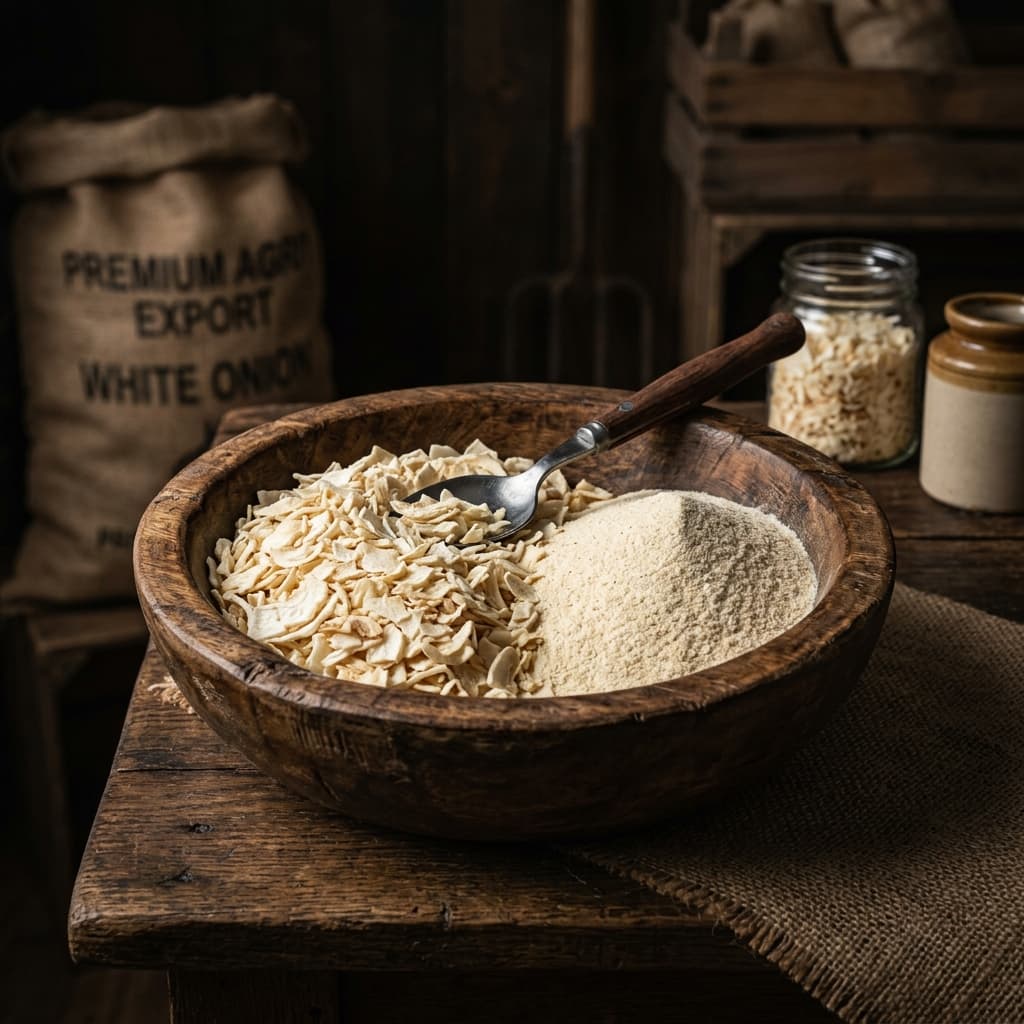
Dehydrated onion is one of those ingredients few consumers think about and almost every processed food relies on. Its market is driven less by household cooking than by the industrial demand of food manufacturers, and that demand has grown steadily as convenience foods, seasonings and ready-meals have expanded worldwide. This primer explains who buys dehydrated onion, what shapes its price, and why a small set of origins — India prominent among them — dominate supply.
Who actually buys dehydrated onion?
The buyers are overwhelmingly industrial rather than retail:
- Food processors making sauces, soups, seasonings, snacks and ready-meals.
- Spice and seasoning blenders building onion into masalas and blends.
- Importers and distributors supplying the food-service and manufacturing trade.
- Private-label and retail brands packing onion flakes and powder for shelves.
Because the demand is industrial, buyers care about consistency, low moisture, microbial safety and reliable supply far more than about brand. A processor reformulating around a supplier’s onion powder needs that powder to be identical, lot after lot.
What drives demand
Three structural trends keep dehydrated onion demand rising: the global growth of processed and convenience foods; the logistical advantages of a shelf-stable, low-weight ingredient over fresh onion; and the steady expansion of the seasonings and snacks categories in emerging markets. Dehydrated onion is lighter to ship, stores for up to two years, and removes the waste and variability of fresh produce — all of which make it attractive to manufacturers managing cost and consistency.
Why India is a leading origin
India is among the world’s largest onion producers, with established dehydration clusters — Gujarat and Maharashtra in particular — that have processed onion for export for decades. The combination of raw-material availability, processing capacity and competitive cost makes India a default origin for buyers in the Gulf, Europe, the United States and Southeast Asia. Other origins such as China and Egypt also supply the market, so buyers typically weigh price against consistency, food-safety credentials and reliability of supply.
Product forms and what shapes price
Dehydrated onion is sold as kibbled flakes, minced, chopped, granules and powder, in white, pink and red varieties. Price is shaped by the fresh onion crop and its seasonal price swings, the form and granulation, moisture and quality grade, food-safety requirements for the destination, and freight. Because the fresh crop is the dominant cost input, dehydrated onion prices move with onion harvests — a factor procurement teams should build into contract timing.
What this means for buyers
For a procurement team, the practical takeaways are to lock specifications tightly, qualify suppliers on consistency and food safety rather than price alone, and time contracts with awareness of the Indian onion crop cycle. Working with a partner who can consolidate across multiple qualified units also smooths supply when any single facility is affected by crop or capacity swings.
Triyara Exports supplies dehydrated onion in every form and variety from India’s leading dehydration belts, with pre-shipment inspection and specification matching on every order.
Reviewed by Triyara Exports LLP
Export specialists focusing on premium Indian agricultural and food products — dehydrated onion and garlic, spices, herbs and agro-commodities. APEDA registered, GST verified and FSSAI licensed. About Triyara →